


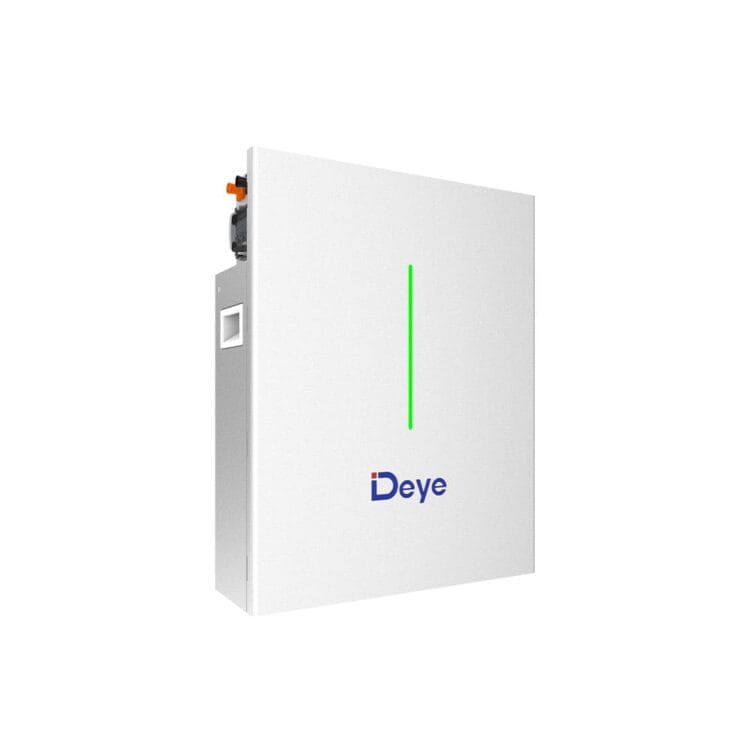
Deye product image and render, and Deye Australia project photos. Check the model number for the exact item.
- Deye Hybrid InvertersWall-mounted inverter, batteries alongside
- Deye AIO Hybrid InvertersInverter sits on top of the battery stack
Your installer confirms the final system and site requirements.
Deye Batteries · RW-F10.2 wall or floor
Deye RW-F10.2 10.2 kWh Battery
RW-F10.2
A 10.2 kWh low-voltage LFP battery in one IP65 case. Hang it on the wall or stand it on the floor beside a Deye hybrid, and add more in parallel as your needs grow.
Inverter, cables and any required PDU/base sold separately.
Not sure how many you need? Get it designed
- Owned and operated by Aussie electricians
- Advice from the electricians who install Deye
Place your order and we email a secure payment link, normally within one business day. Nothing is charged until you pay the link. Free delivery included. Installation is separate. Online Deye Price Beat Guarantee — seen it cheaper? Tell us before you order.
Want a licensed electrician with Deye experience to install this? Click to connect with a Deye installer
How many batteries do you need?
Each RW-F10.2 adds 10.2 kWh. Pick what you would run during a blackout or overnight, then set the number of batteries: we show how long they last, whether they can supply it, and how they go together.
2 batteries (20.4 kWh) run all of this for about 5 h 40 min.
Two RW-F10.2 batteries are rated for 12 kW together, which covers 3.05 kW.
An estimate, not a guarantee. Appliance figures are typical running power. The runtime assumes about 85% of the battery’s nominal kWh reaches your appliances, and the inverter’s own rating also limits what runs at once. Battery ratings are from Deye’s RW-F10.2 datasheet. Its wiring diagram puts a bank on one hybrid inverter of up to 18 kW, at up to 350 A.
Three ways to use it
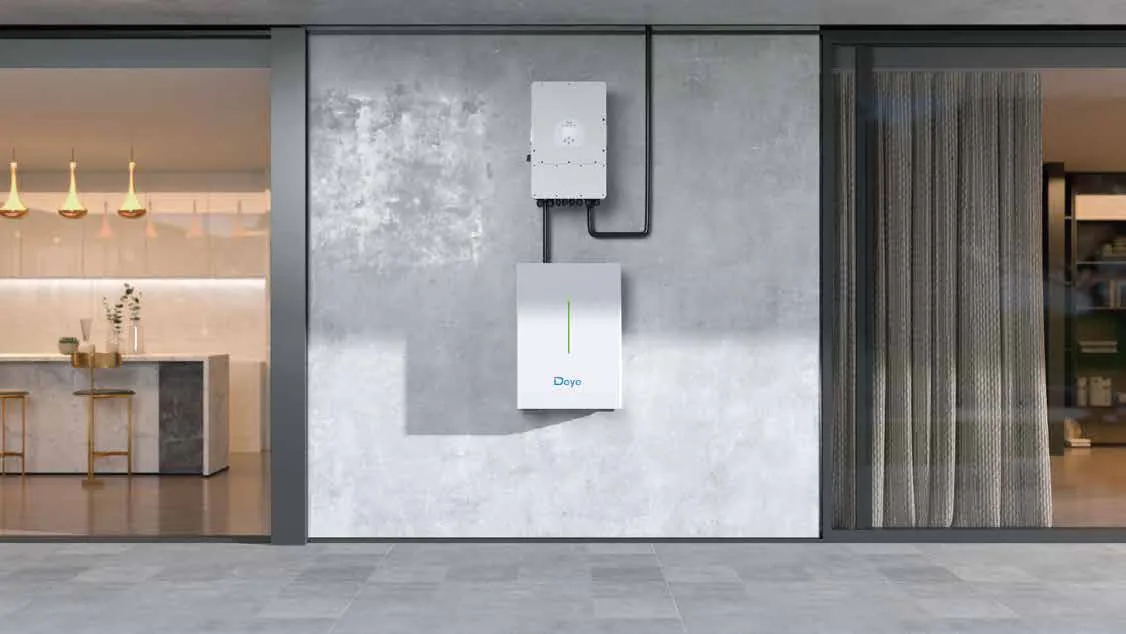
The RW-F10.2 sits beside a wall-mounted Deye hybrid inverter, which runs your solar, battery, home and grid together. We’ll confirm the right set-up for your home.
With a Deye hybrid
Beside a wall-mounted Deye hybrid
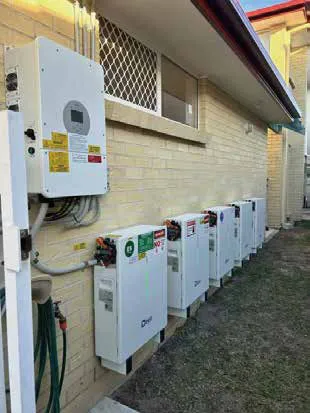
The hybrid charges the RW-F10.2 from your solar and runs your home from it after dark. Deye Australia’s project photos show it with the SUN-8K-SG05LP1-AU, the SUN-10K-SG02LP1-AU and the three-phase SUN-10K-SG04LP3-AU, from one battery to five.
- 10.2 kWh a battery, 9.2 kWh usable
- Up to 32 in parallel: 326 kWh
- On the wall or its floor stand
You’ll need a Deye low-voltage hybrid inverter. Send us its model if you already have one: we check the match and the quantity before you order.
Existing solar
Add a battery to the solar you have
A Deye hybrid can AC-couple to your current solar inverter, so your panels keep working and the RW-F10.2 stores what they make instead of exporting it.
- Keep your panels and current inverter
- Surplus solar charges the battery
- Add more batteries later
AC coupling needs a Deye hybrid inverter and a CT or meter at your switchboard. We check your current inverter and connection first.
Blackouts
Keep the lights on
If the grid goes down, the hybrid runs your backup circuits from solar and the RW-F10.2, and a generator can charge the battery when the sun can’t. More batteries keep it going for longer.
- Backup circuits stay on
- Solar keeps charging the battery
- Generator charging
Your electrician moves the circuits you want kept on to the inverter’s backup port. It is not the whole house unless the system is designed that way.
One case, a lot of storage
10.2 kWh of LFP cells in one IP65 case, on the wall or the floor, with a built-in breaker and battery management system. Connect more in parallel as your needs grow, up to 32.
Installation
On the wall or on its stand
Deye’s flat design hangs on a wall bracket or stands on a removable floor stand. The batteries network themselves when you connect them, with no DIP switches to set, and Deye supports remote monitoring and firmware updates.
- 600 × 760 × 200mm, W × H × D
- 104 kgPer battery
- IP65Enclosure
Inside
LFP cells, a BMS and a breaker
Each RW-F10.2 holds 10.2 kWh of cobalt-free lithium iron phosphate (LFP) cells at 51.2 V. Its battery management system (BMS) watches each cell’s voltage, current and temperature and balances them as they charge, and a 125 A 4P circuit breaker is built in. Deye lists up to 1C charge and 1.2C discharge.
- 10.2 kWhNominal
- 9.2 kWhUsable, at 90% depth of discharge
- 6 kWRated power, 12 kW maximum
At home
Rated IP65, naturally cooled
Deye rates the case IP65, with natural cooling. It discharges from −20 to 55 °C and charges from 1 to 55 °C (−20 to 55 °C with heating on). Your installer chooses the spot to suit Deye’s manual.
- IP65Enclosure
- −20 to 55 °CDischarging
- NaturalCooling
Life and safety
≥ 6,000 cycles
At 25 °C, 0.5C charge and discharge and 90% depth of discharge, until it holds 70% of its capacity.
32 MWh
Energy through each battery over that life, from Deye’s datasheet.
Built-in breaker
125 A 4P, 60 V DC in every battery, with a BMS guarding each cell.
IEC 62619 · UN38.3
The battery safety and transport standards on Deye’s datasheet.
From Deye’s RW-F10.2 datasheet, in Documents.
One to six batteries
Deye’s figures for one RW-F10.2, added up for a bank in parallel. The highlighted row follows the calculator. Usable energy is at 90% depth of discharge; a system’s usable energy depends on its settings.
| Batteries | Energy | Usable | Rated power | Weight |
|---|---|---|---|---|
| 1 | 10.2 kWh | 9.2 kWh | 6 kW | 104 kg |
| 2 | 20.4 kWh | 18.4 kWh | 12 kW | 208 kg |
| 3 | 30.6 kWh | 27.6 kWh | 18 kW | 312 kg |
| 4 | 40.8 kWh | 36.8 kWh | 24 kW | 416 kg |
| 5 | 51 kWh | 46 kWh | 30 kW | 520 kg |
| 6 | 61.2 kWh | 55.2 kWh | 36 kW | 624 kg |
Deye’s wiring diagram puts a bank on one hybrid inverter of up to 18 kW, so from three batteries the inverter sets the power. Deye allows up to 32 in parallel.
Which Deye battery?
The Deye low-voltage batteries we stock. Keep to one battery family in a bank: we check the battery and quantity against your inverter before you pay.
| Feature | AI-W5.1-BDeye battery | RW-F10.2This page | SE-G5.1Pro-BDeye battery | RW-M6.1-BDeye battery |
|---|---|---|---|---|
| Price | incl. GST | $4,087.00 incl. GST | incl. GST | incl. GST |
| Storage | 5.12 kWh nominal | 10.2 kWh nominal | 5.12 kWh nominal | 6.14 kWh nominal |
| Usable energy | 5.12 kWh at manufacturer test conditions | 9.2 kWh at 90% depth of discharge | 4.6 kWh at manufacturer test conditions | 5.53 kWh at manufacturer test conditions |
| Enclosure | IP65 after stacking | IP65 | IP20 | IP65 |
| Mounting | Stacked; wall or floor installation | Wall mounted or floor standing | 19-inch rack, wall or floor mounted | Wall mounted or floor mounted |
| Size (W × H × D) | 720 × 300 × 255 mm | 600 × 760 × 200 mm | 440 × 133 × 540 mm | 510 × 740 × 145 mm |
| Weight | 53 kg | 104 kg | 45 kg | 58 kg |
Pair it with a Deye hybrid
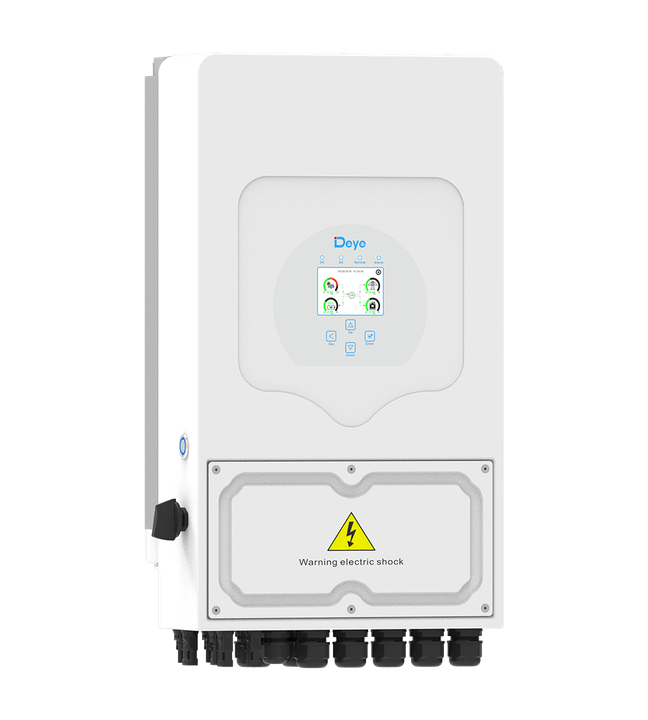
The RW-F10.2 runs with a Deye low-voltage hybrid inverter. Each is a separate item: keep to one battery family in a bank, and we check the inverter, battery and quantity before you pay. These three are with it in Deye Australia’s project photos.
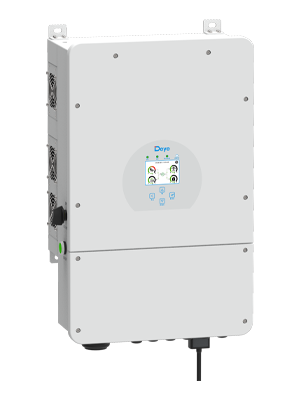
- 10 kW, single phase, wall-mounted
- With the RW-F10.2 in Deye Australia’s project photos
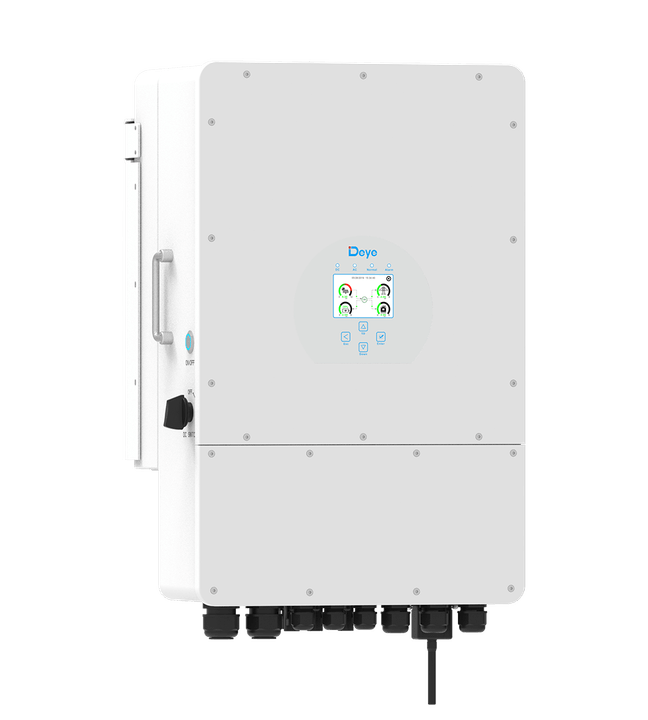
- 8 kW, single phase, wall-mounted
- With the RW-F10.2 in Deye Australia’s project photos
- 10 kW, three phase, wall-mounted
- With the RW-F10.2 in Deye Australia’s project photos
- Single phase 3 to 16 kW, three phase 5 to 20 kW
Your installer confirms the final parts, quantity and layout for your site.
RW-F10.2 batteries installed in Australia
RW-F10.2 batteries with Deye hybrids, one to five at a time, from Deye Australia’s project cases.
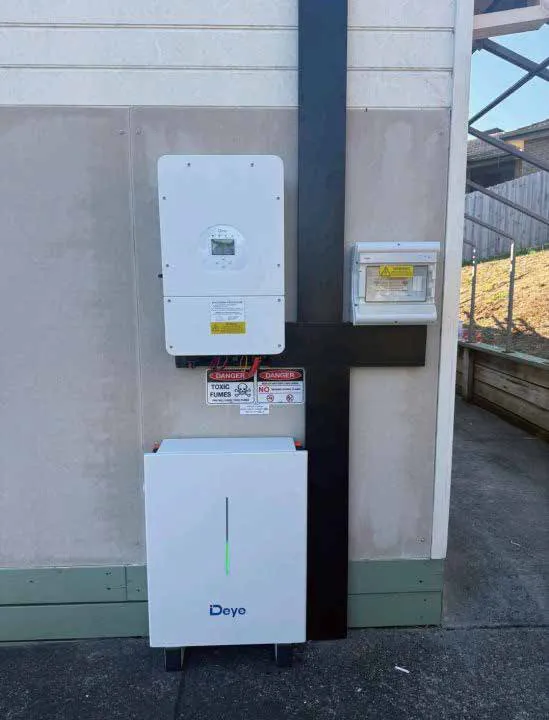
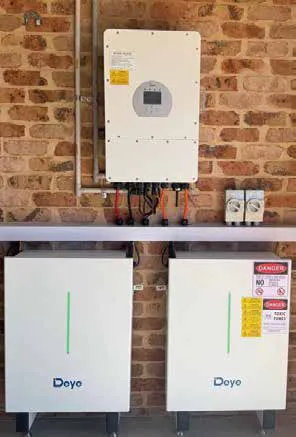
Photos: Deye Australia project cases, from Deye’s March 2026 Australian brochure.
What your electrician will do
- Choose the spotA wall that takes the weight, or level floor for the stand, with room for the batteries side by side and the clearances in Deye’s manual.
- Mount the batteriesEach hangs on its wall bracket or stands on its floor stand. One weighs about 104 kg, so plan the lift.
- Connect the bankParallel cables run from each battery’s OUT terminals to the next one’s IN terminals. The batteries network themselves: no DIP switches.
- Connect the inverterThe first battery connects to the inverter: DC cables to its battery terminals, and the CAN cable so it follows the battery’s BMS.
- Commission itSwitch on the batteries, then the inverter, and set the battery type and work mode. Check the bank in Deye’s monitoring.
RW-F10.2 specifications
Specifications below refer to the manufacturer document shown on this page. Check the document revision and exact model before specifying a system.
| Everest SKU | RW-F10.2 |
|---|---|
| Product type | Floor / wall mount |
| Nominal storage capacity | 10.2 kWh |
| Battery system | Low voltage |
| Cell chemistry | LiFePO₄ (LFP) |
|---|---|
| Nominal module voltage | 51.2 V |
| Capacity | 200 Ah |
| Operating voltage | 43.2–57.6 V |
| Usable energy | 9.2 kWh at 90% depth of discharge |
| Charge / discharge current | 100 A recommended; maximum charge 198 A / discharge 240 A |
| Communication | CAN 2.0 / RS485 |
| Rated DC power | 6 kW |
| Maximum DC power | 12 kW |
| Peak current | 300 A discharge for 2 minutes at 25 °C |
| Charge and discharge rate | Up to 1C charge and 1.2C discharge |
| Recommended depth of discharge | 90% |
| Built-in circuit breaker | 125 A 4P, 60 V DC |
| Mounting | Wall mounted or floor standing |
|---|---|
| Enclosure protection | IP65 |
| Dimensions (W × H × D) | 600 × 760 × 200 mm; see document for mounting exclusions |
| Approximate module weight | 104 kg |
| Size note | Without the hanging board |
| Indicators | State of charge (20–100%) and work state (alarm, protection) |
| Cycle life | ≥ 6,000 cycles (25 ± 2 °C, 0.5C charge and discharge, 90% depth of discharge, to 70% of capacity) |
|---|---|
| Energy throughput | 32 MWh (25 °C, 0.5C charge and discharge, to 70% of capacity) |
| Operating temperature, charging | 1 to 55 °C (−20 to 55 °C with heating on) |
| Operating temperature, discharging | −20 to 55 °C |
| Storage temperature | 0 to 35 °C |
| Humidity | 5–95% |
| Altitude | Up to 3,000 m |
| Cooling | Natural cooling |
| Standards | UN38.3, IEC 62619, CE, CEI 0-21, VDE 2510-50 |
| Batteries in parallel | Up to 32: 326 kWh |
|---|---|
| On one hybrid inverter | Up to 18 kW, with up to 350 A between it and the bank (Deye’s wiring diagram) |
| Parallel terminals | IN and OUT, up to 250 A |
| Set-up | The batteries network themselves: no DIP switches |
| Monitoring | Deye remote monitoring and firmware upgrades |
Product selection and installation must be checked for your site.
RW-F10.2 spec sheets and documents
Deye’s RW-F10.2 datasheet, with the technical data and the wiring diagram for a bank. Read it here, or download a copy.
The document will load when you reach this section.
Pairs with
Build the full system- Deye Hybrid InvertersWall-mounted inverter, batteries alongside
- Deye AIO Hybrid InvertersInverter sits on top of the battery stack
Your installer confirms the final system and site requirements.
Questions about this battery?
Tell us about your inverter, or the one you have in mind, and how much storage you want. The model number travels with your enquiry.
How many RW-F10.2 can I connect?
Deye’s datasheet allows up to 32 in parallel, 326 kWh. Its wiring diagram puts a bank on one hybrid inverter of up to 18 kW, with up to 350 A between them. Tell us your inverter and we check the quantity.
Which inverters work with it?
Deye’s low-voltage hybrid inverters. Deye Australia’s project photos show it with the SUN-8K-SG05LP1-AU, SUN-10K-SG02LP1-AU and SUN-10K-SG04LP3-AU. Send us your inverter model and we check the match before you order.
How much of it can I use?
Deye lists 9.2 kWh usable of its 10.2 kWh at 90% depth of discharge, and recommends 90%. Usable system energy depends on the settings. Our runtime estimates assume about 85% of the nominal kWh reaches your appliances.
How much power can it supply?
Deye rates one RW-F10.2 at 6 kW, with a maximum of 12 kW and peaks of 300 A discharge for 2 minutes at 25 °C. In parallel the ratings add up, and the inverter’s own rating also limits what runs at once.
Can it go outside?
Deye rates it IP65 with natural cooling. It discharges from −20 to 55 °C, and charges from 1 to 55 °C, or from −20 °C with its heating on. Your installer chooses the spot to suit Deye’s manual.
How long will it last?
Deye’s datasheet lists at least 6,000 cycles at 25 °C, charging and discharging at 0.5C to 90% depth of discharge, until it holds 70% of its capacity, and 32 MWh of energy through each battery.
Does it go on the wall or the floor?
Either. It hangs on a wall bracket or stands on its removable floor stand. It is 600 × 760 × 200 mm and weighs 104 kg, so the wall must take the weight: your installer decides.
What protection does it have?
A 125 A 4P, 60 V DC circuit breaker is built in, and its battery management system (BMS) watches each cell’s voltage, current and temperature and balances them as they charge.
Can I add batteries later?
Deye designed it to grow: more connect in parallel, and they network themselves. Tell us what you have now before you add to it, and we check the quantity and the cables.
Is this a complete battery system?
This listing is a battery module or enclosure. The matching inverter, controller or PDU, base or rack, cables and installation requirements depend on the battery family.
Can I mix it with a different battery family?
Do not assume different Deye battery families can be mixed. Send Everest the exact models and details of the existing system for a compatibility check.
Can I order this on its own?
Yes. Add it to your cart, continue to checkout and place your order. We confirm stock and email you a secure payment link, normally within one business day. Nothing is charged until you pay the link. Delivery is free on inverter or battery orders and quoted for parts-only orders. Any installation is arranged separately.
Can Everest help with compatibility?
Yes. Include the model numbers of your existing inverter, batteries and any other system parts in your enquiry. Matching a brand or power rating alone does not confirm compatibility.
More Deye batteries
View the range StackableAI-W5.1-B
AI-W5.1-B
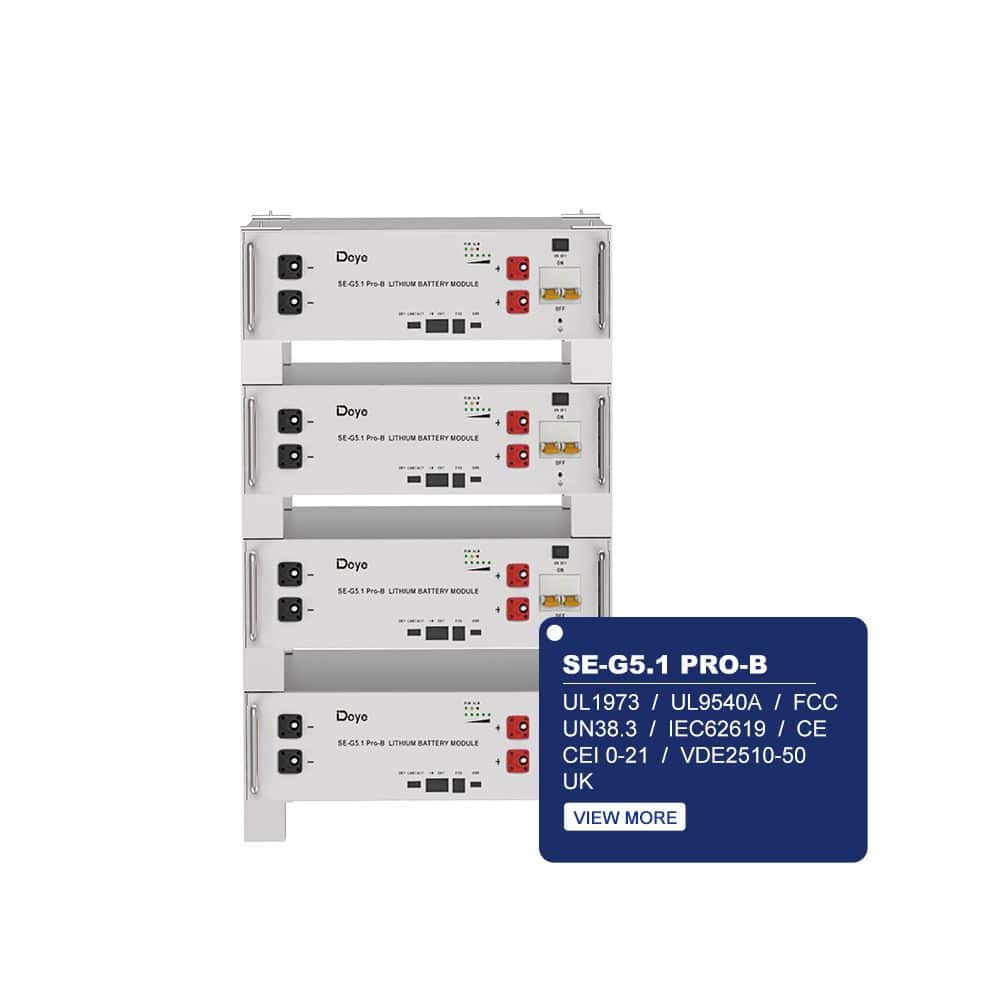 Rack mountSE-G5.1Pro-B
SE-G5.1Pro-B
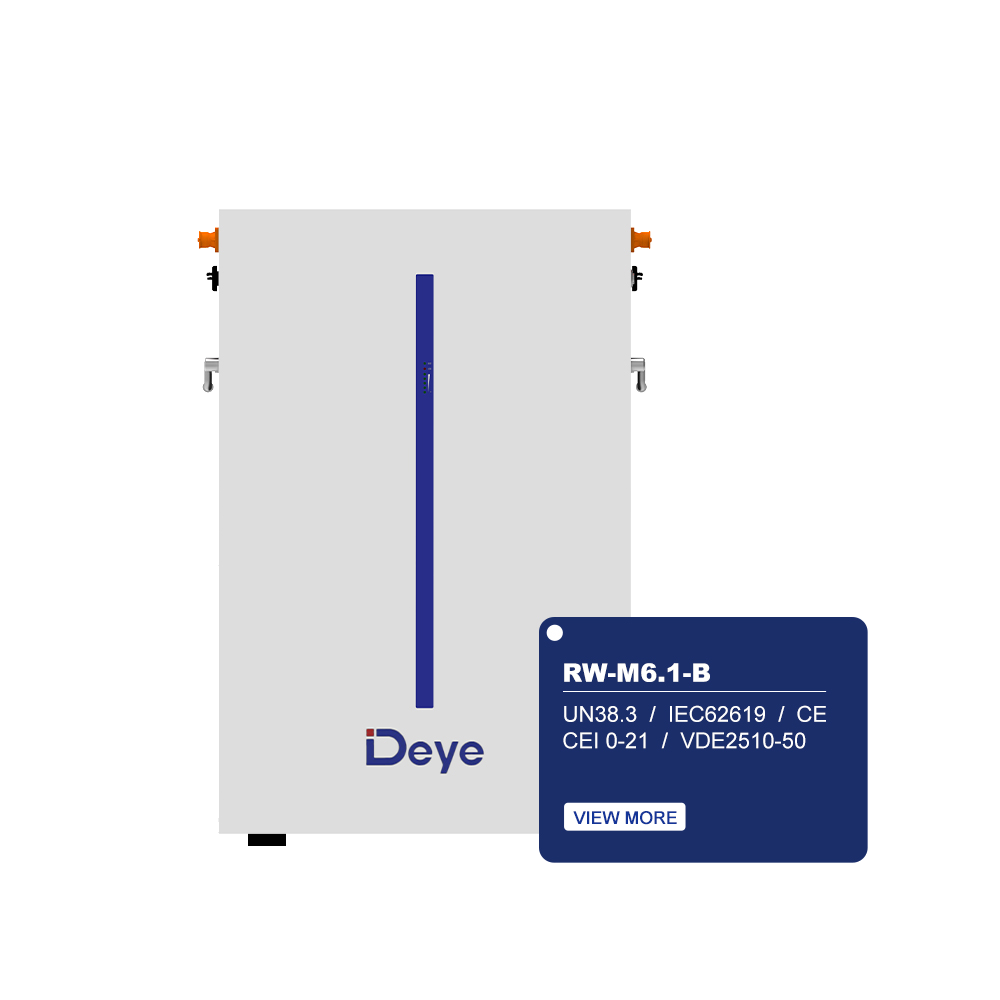 Wall mountRW-M6.1-B
RW-M6.1-B